
Starting a business is exciting.
You have a business name in mind, you may already have a logo, you are thinking about your customers, your products or services, your Instagram page, your office, your marketing—and then suddenly another question comes up:
“Do I need a website?”
And once you start looking into it, the questions keep coming.
How much does a website cost?
Do I need to buy a domain now or later?
What exactly is hosting?
Should I hire a website developer or an agency?
Will a professional website be too expensive for my new business?
Should I choose WordPress or custom coding?
Do I need a static website or a dynamic website?
Don’t worry. These are normal questions, especially when you are building your first business website.
This guide will take you through the process step by step, so you can understand what you actually need, what you are paying for, and when you should spend the money.
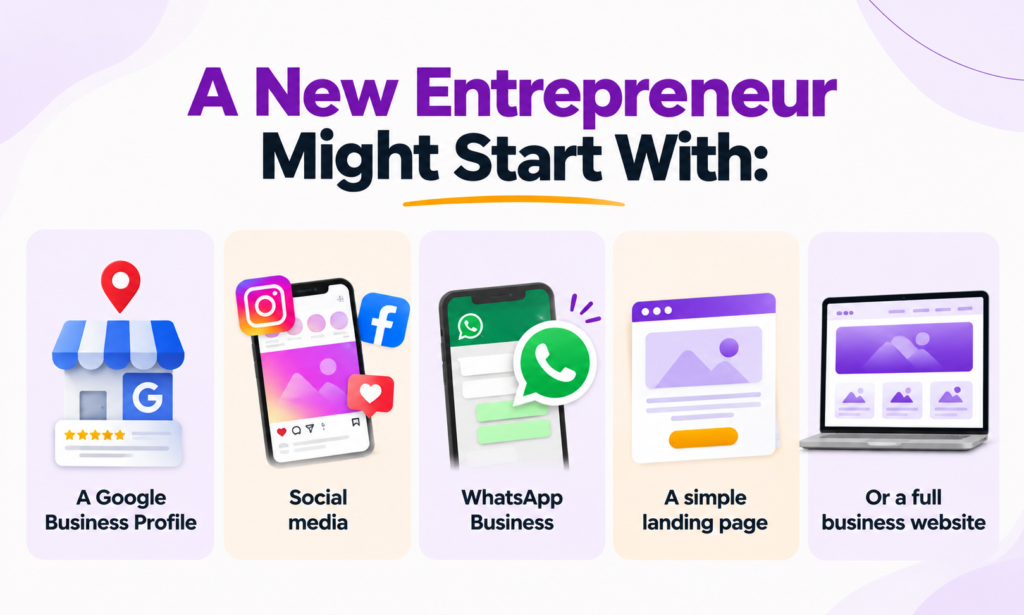
A new entrepreneur might start with:
The right starting point depends on your business model.
For example, a local service business may initially need a simple website with services, location, contact details and enquiry options.
An e-commerce business will need a completely different setup.
So before asking “How much does a website cost?”, the better question is:
“What kind of website does my business actually need?”
That is where the cost starts to change.
We have explained this in a short video here: Watch the video → https://youtube.com/shorts/JaefZbwWT2A
This is one thing I would tell every new entrepreneur:
Once you finalise your business name, check the domain name immediately.
Why?
Because you may decide today that your company name is perfect—and tomorrow discover that the domain name you wanted has already been registered by somebody else.
Your domain is your website’s address, such as:
yourbusiness.com
or
yourbusiness.in
A domain is registered for a period of time and renewed, rather than being something you purchase forever. Current domain pricing varies considerably by provider and extension. For example, one Indian registrar currently lists .in and .com at different annual prices, illustrating why domain cost should be checked with your chosen provider rather than treated as a fixed market price.
Should you choose .com or .in?
For an Indian business, both can make sense.
.in can be a natural choice when your business is primarily focused on India.
.com is widely recognised and can make sense for businesses that want a broader or international presence.
There is no rule that says a .com website automatically ranks better on Google. Google states that the top-level domain itself does not determine search performance.
So don’t spend too much time worrying about whether .com or .in is “better for Google.”
Instead, think about:
Is the name memorable?
Is it easy to spell?
Does it match my brand?
Will my customers remember it?
Should you register the domain for 3 years?
You can.
But registering it for three years is not something you need to do for SEO rankings.
The main reason to register for multiple years is convenience and keeping control of an important business name for longer.
My practical advice?
Once your company name is final, secure the domain before someone else does.
This is where many first-time business owners get confused.
You have bought the domain.
Now someone tells you:
“You also need hosting.”
And you think:
“What is hosting? I just bought my website name!”
Think of it this way:
Domain = your online address
Hosting = the space where your website lives
For example:
Imagine you open a physical shop.
Your domain is like the shop’s address.
Your hosting is like the physical space where your shop, products and furniture are kept.
Your website files, images, databases and other website resources need to live somewhere so people can access the website.
Hosting providers offer different types of hosting depending on what you’re building. Basic business websites can often run on shared hosting, while applications, SaaS products and websites requiring greater server control may use VPS or other infrastructure.
Not necessarily.
This is an important distinction.
Domain: Buy it as soon as your business name is final.
Hosting: Buy it when you are actually ready to build and launch the website.
Some people buy hosting months before they even start their website and then leave it unused.
There is no need to do that.
In a normal website project, your developer or agency can arrange the hosting when the website development is about to begin.
You may hear advice such as:
“Buy hosting three days before the website starts.”
That can be a practical workflow, but it is not a technical or SEO rule. The exact timing depends on the developer, hosting provider and project setup.
What matters is that the domain and hosting are connected correctly and that search-engine crawlers can access the finished website. Google specifically recommends ensuring that Googlebot can access the hosting infrastructure when a site is launched or moved.
When should you buy hosting?
Watch our quick guide: When Should You Buy Hosting? → https://youtube.com/shorts/dh_FQNf6eZU
This is where most entrepreneurs get stuck.
You search for:
“Website development cost in Mumbai”
and you see prices like:
₹10,000
₹20,000
₹50,000
₹1,00,000+
Then you wonder:
“Why is there such a huge difference?”
Because a website is not one fixed product.
The cost depends on what is included.
A basic website may be very simple.
A customised business website may involve strategy, design, copywriting, photography, development, SEO setup and ongoing support.
An e-commerce website can require product management, payment integration, shipping, customer accounts and other functionality.
Custom web applications can cost considerably more again.
Current published Mumbai pricing guides show this wide range: one recent Mumbai guide lists roughly ₹18,000–₹28,000 for a small starter website, ₹30,000–₹60,000 for a larger business website, ₹75,000–₹1.5 lakh for a custom build and ₹1.2 lakh–₹3.5 lakh for e-commerce; another Mumbai agency guide similarly describes pricing as being driven by website type, technology and complexity. These are published agency prices, not a universal Mumbai market rate.
So rather than asking:
“What is the cheapest website?”
Ask:
“What am I getting for the price?”
This is the part many entrepreneurs don’t realise.
The website development fee may be only one part of the total project.
You may also need:
Domain
Your website address.
Hosting
Where your website is hosted.
Website Design
The visual layout, colours, fonts, user experience and overall look.
Development
The actual construction of the website.
Content Writing
The text for your Home, About, Services, Product and other pages.
Images
Stock images, custom photography, graphics or branded visuals.
Videos
Product videos, business videos or other visual content.
SEO Setup
Page titles, headings, URLs, internal linking, image optimisation and other foundational SEO work.
Business Email
For example:
hello@yourbusiness.com
Maintenance & Support
Updates, backups, security, technical changes and ongoing assistance.
That’s why two companies can quote completely different prices for something that both call a “business website.”
This is another very common question.
“Should I hire a website developer?”
or
“Should I hire an agency?”
There is no single answer for every business.
A freelancer can be a practical choice when you already have your content, branding, images and requirements clearly prepared and the project is relatively straightforward.
An agency can be useful when you want more than development.
For example, you may need help with:
Website structure
Content writing
Images and creatives
Brand colours
User experience
SEO
Mobile responsiveness
Domain and hosting
Technical support
Future updates
This is where the difference can become important.
At Kudos, for example, the approach is not simply:
“Send us the content and we’ll make the website.”
The idea is to first understand the business, then decide what the website needs.
Because sometimes the client says:
“I want a five-page website.”
But after understanding the business, you may realise they actually need a landing page, enquiry form, service pages, WhatsApp integration, Google Business Profile optimisation or stronger content.
A website should be built around the business—not just around a template.
Now comes another question many business owners face:
“Should I get a static website or a dynamic website?”
Let’s simplify it.
What is a Static Website?
A static website generally serves fixed content.
For example, imagine a small business website with:
Home
About Us
Services
Gallery
Contact
The information doesn’t need to change frequently.
If you have a simple business and don’t expect to regularly update content yourself, a static website can sometimes be enough.
A dynamic website can generate or update content through a content management system or other backend functionality.
For example:
Blogs
Product catalogues
E-commerce
Customer accounts
Online bookings
Dashboards
Regularly updated content
A WordPress website can be dynamic, and custom-developed websites can also have dynamic functionality.
The important question isn’t:
“Which one is better?”
The better question is:
“Which one suits my business?”
A simple brochure-style business may not need a complicated system.
An e-commerce store obviously needs much more functionality.
A company planning to publish regular blogs and update pages may benefit from a CMS.
Still confused between a Static and Dynamic Website?
Watch our quick explanation: Static vs Dynamic Website → https://youtube.com/shorts/xvee-Haxxtk
There are generally two common paths.
Option 1: Hire a developer or agency
This makes sense when you want:
For complex or highly customised websites, custom development can be appropriate.
Option 2: Build it yourself
Today, platforms such as WordPress, Wix and Shopify make it possible for business owners to create websites without building everything from scratch.
That can be a reasonable option for someone starting out with a limited budget or a simple requirement.
But remember:
Building a website is not the same as building an effective business website.
You still need to think about:
Content
Navigation
Mobile experience
Speed
SEO
Calls to action
Trust
Security
Customer enquiries
A website builder can help you get online. The bigger question is whether the website actually works for your business.
There isn’t one universal number.
Instead, think in terms of the level of website you need.
Basic starter website
Suitable for a new business that mainly needs an online presence.
Usually includes:
A few pages
Business information
Services
Contact details
Basic responsive design
Professional business website
Suitable for businesses that want a stronger online presence and lead generation.
May include:
Custom design
Multiple service pages
Professional content
SEO-friendly structure
Lead forms
WhatsApp integration
Mobile optimisation
Analytics
Better branding
E-commerce website
Suitable for businesses selling products online.
May include:
Product pages
Categories
Shopping cart
Payment gateway
Order management
Shipping integration
Customer accounts
Custom website or web application
Suitable for businesses with specific functionality that standard website platforms cannot easily provide.
May require:
Custom coding
Database development
APIs
Dashboards
User login
Custom workflows
So when somebody asks:
“What is the cost of a website in Mumbai?”
the honest answer is:
It depends on what your business actually needs.
This is something many business owners realise only after the website project has already started.
The developer asks:
“Please send the website content.”
And suddenly you think:
“What content?”
You need to answer questions like:
What does your company do?
What services do you offer?
Why should someone choose you?
Who are your customers?
What areas do you serve?
What should someone do after visiting the website?
This is why a good website project often involves more than just coding.
Design + Content + Development + SEO + Strategy
All of these can affect the final website.
You may think:
“I’ll make the website first and do SEO later.”
That is possible, but ideally your website should be built with SEO-friendly foundations from the beginning.
Google recommends creating helpful, reliable, people-first content and using words that people actually use when looking for your content. It also recommends making links crawlable and ensuring that search engines can access and understand your pages.
For example, instead of a page simply called:
Services
you might have separate, useful pages such as:
Website Design Services
SEO Services
Social Media Marketing
Google Business Profile Services
The exact structure depends on the business.
This is becoming another question business owners are asking:
“Will my website only show on Google, or can AI tools find it too?”
AI search is changing how people discover information.
Google now has AI features in Search, while ChatGPT Search can surface public websites and link to sources. OpenAI says websites should not block OAI-SearchBot if they want their content to be eligible for discovery and citation in ChatGPT Search.
But there is no magic trick that guarantees your website will appear in ChatGPT or Perplexity.
The basic principle is still:
Create genuinely useful content that clearly answers real questions.
That’s one reason we’re writing guides like this one.
Instead of only writing:
“We are the best website design agency.”
a useful article answers:
How much does a website cost?
Do I need a website for my business?
What is hosting?
Should I choose WordPress or custom development?
What is the difference between static and dynamic websites?
That is useful to a real person—and easier for search systems to understand.
Let’s make it very simple.
Starting your business?
↓
↓
↓
↓
↓
↓
↓
↓
↓
The biggest mistake isn’t necessarily spending too much.
Sometimes it is spending money without knowing what they actually need.
Someone may pay ₹15,000 for a website and later realise they need new pages, better content, SEO, forms, integrations and redesign work.
Another person may spend ₹1 lakh on a complicated website when a much simpler website would have been enough for their current stage.
The goal isn’t to get the cheapest website.
The goal is to build the right website for your business stage.
Your website should be able to grow as your business grows.
Before saying yes to any developer or agency, ask:
Is domain included?
Is hosting included?
Who owns the domain?
How many pages are included?
Is the website mobile responsive?
Who writes the content?
Are images included?
Is basic SEO included?
Will I get access to my website?
Who will maintain the website after launch?
What happens if I need changes later?
Is SSL included?
Are business email accounts included?
These questions can save you from surprises later.
A website can be your:
Online storefront.
Information centre.
Lead-generation tool.
Brand presentation.
Trust-building platform.
And for some businesses, it can also become a complete sales channel.
So don’t start with:
“How cheaply can I build a website?”
Start with:
“What does my customer need when they visit my website?”
Once you know that, choosing the right technology, team and budget becomes much easier.
At Kudos Digital, we don’t just make websites.
We first try to understand your business, your customers and what you actually need.
From website planning and design to content, creatives, SEO-friendly structure and ongoing support, we can help you build an online presence around your business.
📞 +91 81047 20700
Kudos Digital — Website Design with Personal Attention.
Kudos Digital brings 15 years of branding expertise and 8 years of digital marketing experience to help grow your business with tailored digital marketing solutions.
Introduction: How Much Does a Website Cost in Mumbai? A Complete Guide for Small Businesses
+91 81047 20700
